
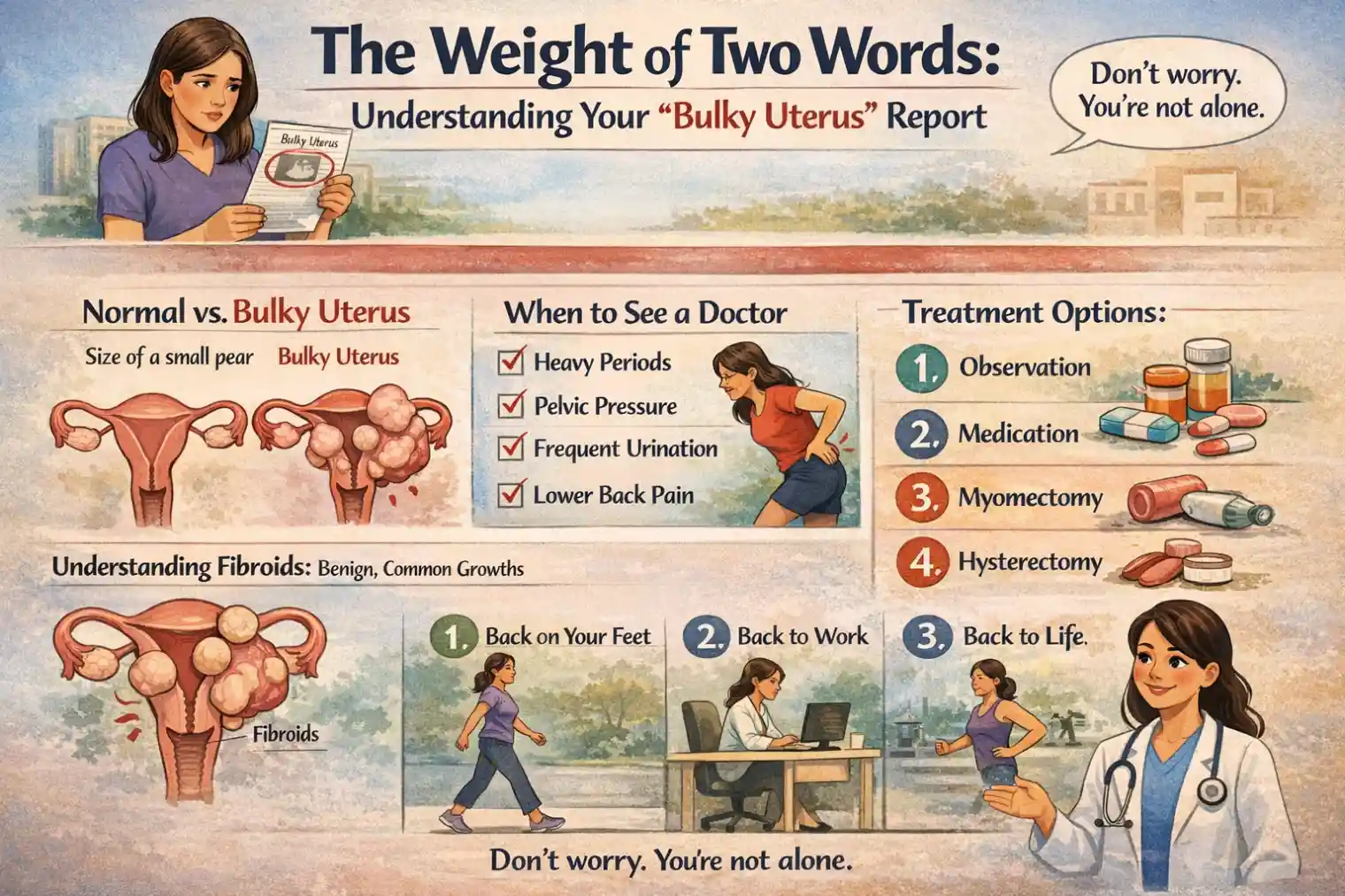
You’re holding that crisp sheet of thermal paper, and your eyes keep darting back to two words: “Bulky Uterus.” It sounds heavy, doesn’t it? It sounds like a diagnosis that demands immediate worry.
As a gynecologist who has sat across from thousands of women in this exact moment, let me ask you to take a deep breath and set that report down for a second.
Here is the truth: A bulky uterus is one of the most common findings in clinical practice. It is not a death sentence, it is almost never cancerous, and in many cases, it is simply your body’s way of showing its history. Whether you’ve had children, are approaching a new phase of life, or have a bulky uterus fibroid, you are not “broken.” You are simply at a starting point for better health.
What Does “Bulky” Actually Mean?
In the medical world, we love our adjectives. A “normal” uterus is roughly the size of a small pear. When an ultrasound technician describes it as “bulky,” they simply mean it has enlarged beyond those standard dimensions.
Think of it like a favorite pair of shoes that has stretched over time. It’s still a shoe; it just occupies a bit more space. The most frequent culprit behind this change is a bulky uterus fibroid.
The “Uninvited Guest”: Understanding Fibroids
If your report mentions a bulky uterus fibroid, don’t let the terminology alarm you. Fibroids are benign (non-cancerous) growths of muscle tissue. They are incredibly common—so common, in fact, that nearly 70-80% of women will develop them at some point in their lives.
They aren’t “dangerous” in the sense that they turn into cancer. Their “danger” lies entirely in how much they interfere with your happiness. They are like uninvited houseguests: they might just sit quietly in the corner (asymptomatic), or they might start taking up too much room and making a mess (heavy bleeding and pain).
Should You Be Worried? (The Checklist)
If you have no symptoms, a bulky uterus is often just a “finding,” not a “problem.” However, it’s time to have a real conversation with your doctor if you recognize these signs:
- The “Heavy” Period: If you’re planning your life around your cycle or carrying “emergency” supplies everywhere.
- The Constant Pressure: A feeling of fullness in your lower belly, as if you’ve eaten a large meal that won’t go away.
- Frequent Pit Stops: The uterus sits right near the bladder. If it’s bulky, it presses down, making you feel like you need to run to the washroom every hour.
- The Dull Ache: Lower back pain or pelvic pressure that lingers.
The Roadmap: Your Treatment Options
We treat the woman, not the ultrasound report. Depending on your symptoms and your stage in life, we have a clear hierarchy of care.
1. Observation (Active Monitoring)
If your fibroids are small and your life is unaffected, we do nothing. We watch. We will scan again in six months. Many women carry a bulky uterus into menopause, at which point fibroids often shrink naturally as hormone levels drop.
2. Medical Management
We can use modern hormonal treatments to “quiet” the symptoms. These aren’t just about birth control; they are about regulating the lining of the uterus so you don’t lose as much blood, allowing your energy levels to return.
3. Targeted Removal (Myomectomy)
If you wish to preserve the uterus—perhaps you’re planning a family or simply prefer to keep your anatomy intact—we can remove just the bulky uterus fibroid itself. This is often done via “keyhole” (laparoscopic) surgery, meaning smaller scars and faster healing.
4. The Definitive Solution (Hysterectomy)
For women who are done with childbearing and are exhausted by years of heavy bleeding and pain, a hysterectomy offers a permanent “reset.”
The Modern Recovery: Getting Your Life Back
The word “surgery” often conjures up images of weeks in a hospital bed. That is an outdated narrative.
With advanced laparoscopic techniques, the recovery for bulky uterus treatments has been transformed:
- Days 1-2: Most patients are walking and eating light meals within 24 hours.
- Week 2: You are usually back to light desk work and short walks. The “heaviness” you felt for months (or years) is replaced by a surprising sense of physical lightness.
- Week 6: Full clearance. You can return to the gym, your hobbies, and your normal life—minus the fatigue and the worry.
A Final Note from My Desk
If you are holding that USG report today, remember: Knowledge is the end of fear. A bulky uterus is a condition, not a crisis. It is a manageable, treatable, and very common part of being a woman.
Don’t spend your night scrolling through anonymous forums. Let’s look at your scans together, talk about your lifestyle, and decide if we need to take action or simply keep a watchful eye. You deserve to feel light again.