
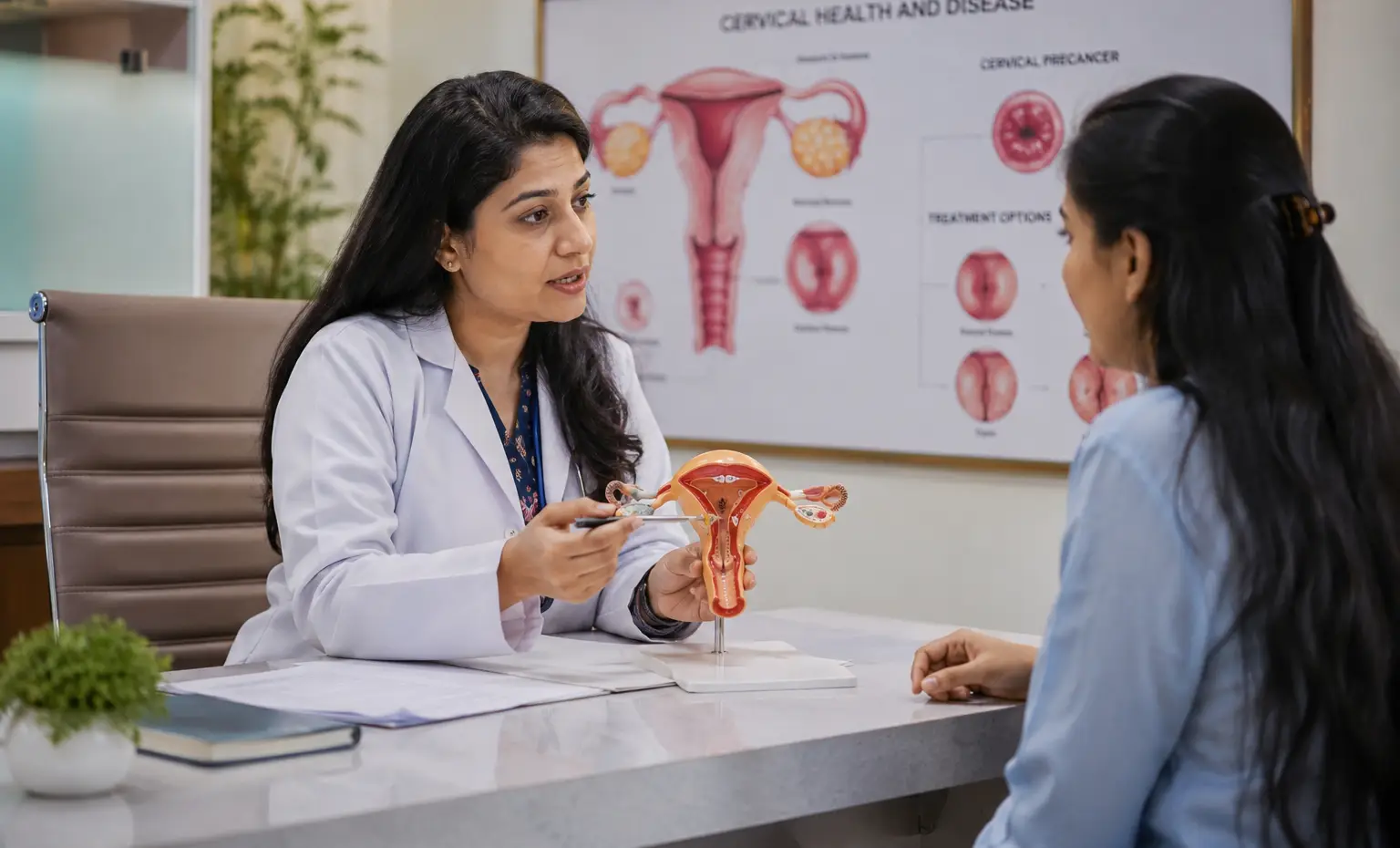
“Doctor, my report says CIN. Do I need surgery?”
For many women, seeing terms like CIN 1, CIN 2, dysplasia, precancerous lesion, or abnormal cervical cells on a report can be frightening. The immediate fear is often the same:
“Do I have cancer?”
Fortunately, in most cases, the answer is no.
Cervical precancer refers to abnormal changes in the cells of the cervix that have the potential to become cancer over time if left untreated. These changes are not cancer themselves. In fact, many precancerous conditions can be successfully managed before cancer ever develops.
This is why modern gynecologic oncology focuses heavily on prevention rather than simply treatment. Through early diagnosis, careful monitoring, and minimally invasive procedures, many women can avoid major surgery altogether.
Advances in Cervical Precancer Services in Mumbai, including CIN 1 CIN 2 treatment, Cryotherapy for cervix, Cold knife conization, and other forms of Preventive gynae care, have transformed outcomes for women diagnosed with precancerous cervical changes.
Under the guidance of Dr Maitreyee Parulekar, women can access specialized care aimed at preserving cervical health while preventing progression to cancer.
The Diagnosis That Sounds Scarier Than It Often Is
One of the biggest misconceptions surrounding cervical precancer is that it automatically leads to cancer.
The reality is much more reassuring.
Most cervical precancers are detected because of routine screening tests such as PAP smears, HPV testing, or colposcopy. These tests identify abnormal cells long before they become dangerous.
The term CIN (Cervical Intraepithelial Neoplasia) is commonly used to describe these changes.
Doctors generally classify abnormalities as:
- CIN 1 – Mild cellular changes
- CIN 2 – Moderate abnormalities
- CIN 3 – Severe abnormalities with higher progression risk
Not every abnormality behaves the same way.
Some may disappear naturally, while others require treatment to prevent future complications.
This is why individualized assessment remains essential.
Why is HPV Usually the Starting Point?
Behind most cervical precancer diagnoses lies one common factor: HPV.
Human Papillomavirus is an extremely common viral infection. Most infections clear spontaneously, but persistent infection with high-risk HPV strains can cause abnormal changes within cervical tissue.
The process is usually slow.
A woman may carry high-risk HPV for years before any significant abnormalities develop.
Factors that may increase persistence include:
- Smoking
- Weakened immunity
- Long-standing HPV infection
- Multiple risk factors affecting cervical health
Because HPV-related changes occur gradually, doctors often have an opportunity to intervene before cancer develops.
This is one reason why preventive gynae care plays such an important role in women’s health.
CIN 1 vs CIN 2: Why Treatment Isn’t Always the Same?
Many women assume that every cervical abnormality requires immediate treatment.
That is not always true.
CIN 1
CIN 1 represents mild abnormalities confined to the lower portion of the cervical lining.
In many women, CIN 1 resolves naturally as the immune system clears HPV.
Doctors may recommend:
- Observation
- Repeat PAP smears
- HPV testing
- Follow-up colposcopy
CIN 2
CIN 2 indicates more significant cellular abnormalities.
Because CIN 2 has a greater likelihood of progression, treatment is often considered depending on:
- Age
- Fertility plans
- HPV status
- Extent of abnormalities
This is where specialized CIN 1 CIN 2 treatment becomes important.
The goal is not only removing abnormal cells but also preserving future reproductive health whenever possible.
Can Cervical Precancer Be Treated Without Major Surgery?
The simple answer is yes.
Most women diagnosed with cervical precancer do not require major surgery.
Modern treatment strategies focus on removing or destroying abnormal tissue while preserving healthy cervical structure.
Depending on the severity of abnormalities, treatment options may include:
- Observation and monitoring
- Cryotherapy
- LEEP
- Laser treatment
- Cone biopsy procedures
The choice depends on several factors including age, pathology findings, and future pregnancy plans.
The emphasis today is on minimally invasive management whenever appropriate.
How Cryotherapy for Cervix Works?
One of the simplest treatments for selected cervical abnormalities is Cryotherapy for cervix.
Cryotherapy uses extremely cold temperatures to destroy abnormal tissue.
During the procedure:
- A specialized probe is applied to the cervix.
- Abnormal cells are frozen.
- The damaged tissue gradually sheds.
- Healthy tissue regenerates over time.
Benefits of Cryotherapy for cervix include:
- Quick outpatient procedure
- No large surgical incision
- Minimal discomfort
- Fast recovery
- Effective treatment for selected lesions
For appropriately selected patients, cryotherapy can provide an excellent balance between effectiveness and simplicity.
When Is Cold Knife Conization Recommended?
Some abnormalities require more detailed evaluation and treatment.
In these situations, cold knife conization may be recommended.
This procedure involves removing a cone-shaped portion of cervical tissue containing the abnormal area.
Unlike destructive procedures that eliminate tissue, cold knife conization allows pathologists to carefully examine the removed specimen.
Doctors may recommend it when:
- High-grade lesions are present
- Abnormalities extend deeper into cervical tissue
- Earlier tests provide incomplete information
- More precise diagnosis is required
Advantages of Cold knife conization include:
- Accurate tissue assessment
- Removal of abnormal areas
- High treatment success rates
- Preservation of the uterus and fertility in many cases
Although more extensive than cryotherapy, it is still considerably less invasive than major cancer surgery.
Why Early Detection Changes Everything?
Perhaps the most important factor influencing outcomes is timing.
The earlier cervical abnormalities are identified, the simpler treatment tends to be.
Women diagnosed during the precancer stage often benefit from:
- Less invasive procedures
- Shorter recovery times
- Better fertility preservation
- Reduced healthcare costs
- Lower cancer risk
Studies consistently show excellent outcomes when precancerous lesions are identified and treated appropriately.
In many cases, early intervention prevents progression entirely.
This is why screening remains the foundation of successful cervical cancer prevention.
The goal is not simply to detect disease.
The goal is to stop disease before it develops.
The Role of Preventive Gynae Care in Long-Term Women’s Health
Many women associate gynecological visits only with pregnancy or symptom-related concerns.
However, some of the most important appointments are preventive.
Routine gynecological evaluations help identify:
- HPV infections
- Cervical abnormalities
- Hormonal concerns
- Reproductive health issues
- Early gynecologic cancers
Comprehensive preventive gynae care empowers women to make informed decisions before problems become serious.
Regular follow-up, appropriate screening, and individualized risk assessment remain the cornerstone of cervical health.
Why Specialized Care Matters?
Every abnormal PAP smear does not require treatment.
Every CIN diagnosis does not require surgery.
Every patient has unique needs.
As a specialist in gynecologic oncology, Dr Maitreyee Parulekar focuses on balancing effective treatment with preservation of long-term health.
Her expertise includes:
- Advanced cervical disease evaluation
- Colposcopy assessment
- Management of precancerous lesions
- CIN 1 CIN 2 treatment
- Cryotherapy for cervix
- Cold knife conization
- Comprehensive Preventive gynae care
This personalized approach helps ensure that women receive the most appropriate treatment while avoiding unnecessary procedures.
A diagnosis of cervical precancer can feel overwhelming, but it is important to remember that precancer is not cancer.
In fact, identifying abnormal cervical cells before cancer develops is one of the greatest successes of modern women’s healthcare.
With advances in Cervical Precancer Treatment in Mumbai, many women can be successfully treated without major surgery. Options such as Cryotherapy for cervix, specialized CIN 1 CIN 2 treatment, and Cold knife conization provide effective solutions while preserving quality of life and future reproductive potential.
Most importantly, early detection changes outcomes.
Through regular screening, expert evaluation, and ongoing Preventive gynae care, women can take proactive steps to protect themselves long before cancer develops.
FAQs
1. Does CIN mean I have cervical cancer?
No. CIN refers to precancerous cellular changes and does not mean cancer is present.
2. Can CIN 1 disappear without treatment?
Yes. Many CIN 1 lesions resolve naturally and may only require monitoring and follow-up.
3. Is Cryotherapy for the Cervix painful?
Most women experience mild discomfort, but the procedure is generally well tolerated and performed on an outpatient basis.
4. Why is cold knife conization performed?
It removes abnormal cervical tissue and allows detailed pathological examination to guide treatment decisions.
5. Can cervical precancer be treated without removing the uterus?
Yes. Most women with cervical precancer can be treated using conservative procedures without hysterectomy or major surgery.