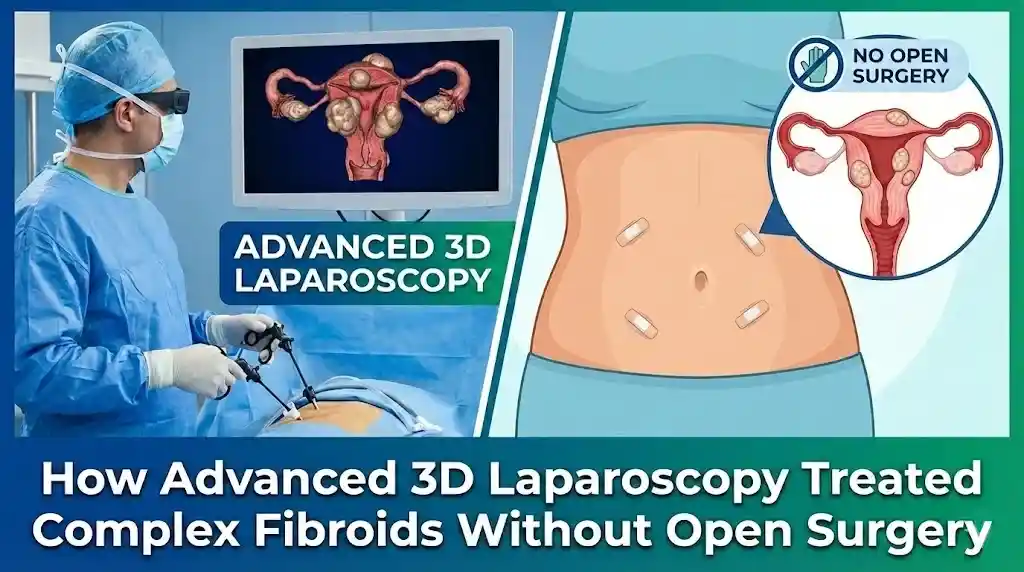
Case Study: How Advanced 3D Laparoscopy Treated Complex Fibroids Without Open Surgery
There is a common myth in gynecology that I hear from patients in my Mumbai clinic almost every week: “Doctor, I’ve been told my fibroids are too large, too multiple, or too complicated for laparoscopic surgery. I have no choice but to get a big cut (open surgery).”
Today, I want to share a recent case that proves this myth wrong.
While traditional open surgery has its place, advances in 3D Laparoscopy now allow us to handle even the most critical, complex cases through tiny incisions. This means less pain, minimal scarring, and a faster return to your life.
The Silent Danger: More Than Just “Heavy Periods”
Fibroids are often dismissed as just causing heavy bleeding or pain. But in severe cases, they can silently damage other organs.
We recently treated a 43-year-old patient who came to us with a distended abdomen and discomfort. Her condition was far more serious than simple fibroids. Her uterus was significantly enlarged, distorted by multiple fibroids located in difficult positions—including a large 8×7 cm fibroid in the posterior fundus and several others scattered throughout the uterine wall.
But the real danger was what the fibroids were doing to her internal organs.
The Critical Complication: Kidney Damage
Upon reviewing her MRI Pelvis, we discovered that her enlarged uterus was chronically compressing the right ureter (the tube connecting the kidney to the bladder) at the pelvic brim.
This blockage had caused severe right hydronephrosis (swelling of the kidney due to urine build-up), resulting in a “paper-thin cortex”. A subsequent Renal Scan confirmed our fears: the right kidney was “non-visualized” and non-functioning [Renal Scan Report].
The fibroids had silently exerted so much pressure over time that one kidney had completely lost function. The priority was now to remove the uterus (Hysterectomy) safely to relieve the pressure, protect the remaining healthy kidney, and improve her quality of life.
The Challenge: Adhesions & Anatomy
This was not a standard hysterectomy. The MRI revealed significant surgical challenges:
- Adhesions: The uterus was stuck (adherent) to the urinary bladder anteriorly and the rectosigmoid colon (bowel) posteriorly.
- Distorted Anatomy: The massive size of the fibroids had displaced the pelvic organs, making navigation risky.
Many surgeons would opt for Open Surgery (Laparotomy) in a case like this to avoid injuring the bowel or bladder. However, open surgery comes with a long, painful recovery—something we wanted to avoid for our patient.
The Solution: Total 3D Laparoscopic Hysterectomy
We decided to proceed with a Total 3D Laparoscopic approach.
Unlike standard 2D laparoscopy, 3D technology gives surgeons depth perception. It allows me to see the tissue planes between the uterus, the bladder, and the bowel with crystal-clear precision. This is critical when separating organs that are stuck together.
The Procedure Highlights:
- Precision Dissection: Using 3D visualization, we carefully separated the dense adhesions between the uterus, the bladder, and the bowel without causing any injury to these sensitive organs.
- Complete Removal: Despite the large volume of the specimen (see image below), the entire uterus and all fibroids were removed through the laparoscopic ports.
- No Big Cuts: The patient woke up with only tiny marks, not a large abdominal scar.
Figure 1: The specimen extracted laparoscopically, showing the multiple fibroids that were causing organ compression.
Why This Matters to You
If you have been diagnosed with large fibroids or adenomyosis, do not assume open surgery is your only option.
Key Takeaways from this Case:
- Size isn’t the only factor: Even large, multiple fibroids can often be removed laparoscopically by a skilled surgeon.
- Check your kidneys: If you have large fibroids, ensure your doctor checks for “pressure effects” on your ureters. This patient had no idea her kidney was at risk until it was too late for that organ.
- Technology saves recovery time: 3D Laparoscopy offers the safety profile of open surgery (in terms of visibility) with the recovery benefits of keyhole surgery.
Expert Care in Mumbai
Every woman’s body is different, and surgery is never “one size fits all.” However, advancements in medical technology mean that women no longer have to suffer through major open surgeries for benign conditions like fibroids.
If you have been advised open surgery and want a second opinion on minimally invasive options, let’s discuss if Laparoscopy is right for you.
Dr. Maitreyee Parulekar
Consultant Gynecologist & Laparoscopic Surgeon Mumbai