
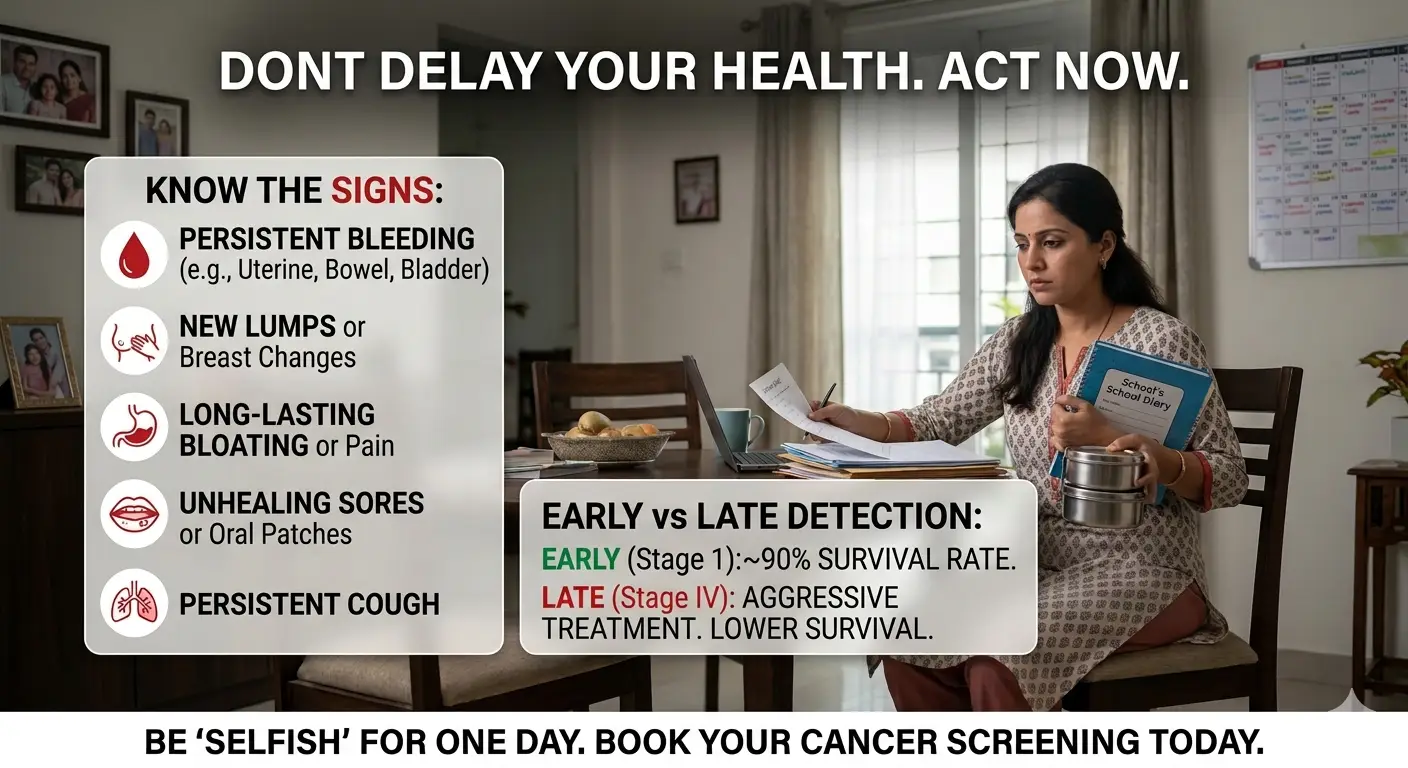
You are the CEO of your home, the strategist at your office, and the primary caregiver for everyone—except yourself. In India, we have a cultural habit of “adjusting.” We adjust to the backache, we adjust to the fatigue, and we certainly adjust to “minor” body changes.
Projections from the National Cancer Registry Programme (ICMR) and recent global studies indicate that India is now seeing approximately 1.87 million new cancer cases annually. The real tragedy isn’t the diagnosis; it’s the timing. While 1 in every 9 Indians will develop cancer in their lifetime, the majority are still diagnosed in Stage III or IV. In a country with world-class medical facilities, we are losing lives not to the disease, but to the delay.
The “Silent” Red Flags: Symptoms You Cannot Negotiate With
Cancer doesn’t always start with a scream; it often starts with a whisper. If you notice any of the following, please stop “observing” it for another month.
1. The “Post-Everything” Bleeding
If you have reached menopause and see even a single drop of blood—that is an emergency until proven otherwise. Similarly, bleeding after intimacy or between your regular cycles should never be dismissed as “just a hormonal fluke.” It is the primary signal for Cervical or Endometrial cancer.
2. The Persistent Bloat
We all feel bloated after a heavy meal. But if you feel a “fullness” that lasts for more than two weeks, or if your clothes feel tight around the waist while the rest of you is losing weight, pay attention. This is often the only early warning sign of Ovarian cancer, which is notoriously difficult to catch early unless you listen to that “gut feeling.”
3. The Lump That Doesn’t Hurt
There is a dangerous myth that “if it doesn’t hurt, it isn’t cancer.” Actually, early-stage Breast cancer lumps—which now affect nearly 2 lakh Indian women annually—are usually painless. Check for dimpling of the skin, a nipple that has started pointing inward, or unusual discharge.
4. The Change in Your “Basics”
Cancers like Colorectal or Bladder cancer (common in both men and women) show up in your bathroom habits.
- Blood in the stool: Often dismissed as piles, but needs verification.
- Persistent change in bowel movements: Diarrhea or constipation lasting over three weeks.
- Blood in the urine.
Cancers We Share: Beyond the Pink Ribbon
While we focus heavily on “women’s cancers,” we must address the giants that affect everyone in India: Oral and Lung cancers.
- Oral Cancer: India has one of the highest rates globally. Look for a white or red patch in the mouth or a sore that doesn’t heal in 10 days.
- Lung Cancer: It is no longer just a “smoker’s disease.” With urban air pollution reaching critical levels in 2026, we are seeing a rise in lung cancer among non-smoking women. A cough that lasts three weeks is a red flag.
The Power of “Stage 1” vs. “Stage 4”
In India, the survival gap is almost entirely down to the Stage.
| Feature | Stage 1 (Early) | Stage IV (Late) |
| Detection | Caught during a routine screening or at the first sign of a “whisper” symptom. | Caught when pain becomes unbearable or other organs fail. |
| Treatment | Minimal. Often just a targeted surgery or short therapy. | Aggressive. Requires systemic chemotherapy and radiation. |
| The Outcome | 90%+ Survival Rate for most common cancers. | Significantly lower and focused on “management” rather than a cure. |
A Final Word: Be “Selfish” for One Day
The reason cancer is diagnosed late in India isn’t just a lack of hospitals; it’s the “I’ll be fine” mindset. But cancer is most curable when it is least painful.
As of February 2026, the WHO estimates that 4 out of 10 cancers in India are entirely preventable through lifestyle changes and early vaccination (like the HPV vaccine for cervical cancer).
Don’t wait for the pain. Early detection is not just a medical term; it is the difference between a diagnosis and a tragedy.
Be the CEO of your health today. Book that screening.